Graphics /Discover / Transformations
Transformations
scenario
Move the Object, Not the Model
You have one stored shape: a chair, icon, vehicle part or simple polygon. Now the same geometry is needed in several places, at different sizes and orientations. Writing a second hand-edited vertex list for every copy would duplicate information and make later changes to the source shape difficult to propagate.
The connectivity does not need to change. What changes are the coordinates assigned to the same corresponding points.
You therefore need a reusable way to map each source point to a new point, then apply that mapping consistently across all of the object's vertices.
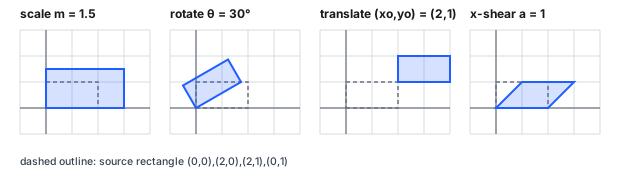
What information should a reusable point-mapping rule take as input and produce as output so that one stored shape can be reused in different placements, sizes and orientations?