Graphics / Reference / Objects transform vertex by vertex
Objects transform vertex by vertex
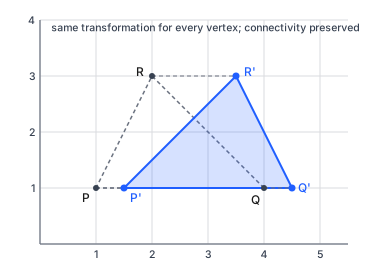
An object is transformed by applying the same coordinate transformation independently to every vertex. The transformed vertices are then drawn using the object's original connectivity.
If an object is represented by vertices and the connections between them, transform the object by applying the same transformation to every vertex.
For vertices p0, p1, ..., pn and transformation T:
p0' = T(p0) p1' = T(p1) ... pn' = T(pn)
The transformed object is then reconstructed from p0', p1', ..., pn' using the same edge or polygon connectivity as the original object.
The transformation changes vertex positions; it does not require redefining which vertices are connected. This is what allows one stored model to be reused with different scales, orientations or placements.
When implementing a matrix transformation, calculate each output coordinate from the original vertex coordinates rather than overwriting an input component before all outputs have been computed.
The standard diagram shows an original triangle and a transformed copy, with dashed lines pairing each original vertex with its corresponding transformed vertex.
Builds on
Read
- Read the chapter: Objects transform vertex by vertex