Graphics / Reference / Scanline fill
Scanline fill
Scanline filling processes a raster region one horizontal row at a time. Each row is represented by one or more horizontal spans bounded by the region's intersections with that scanline; a rectangle has one fixed span per row.
Scanline filling processes a raster region one horizontal row at a time. On each row, the region contributes one or more horizontal spans between boundary intersections; the simple axis-aligned rectangle case has one span whose limits remain constant from row to row.
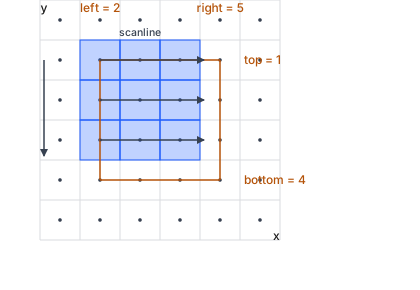
Using the y-down convention used by the triangle experience, an axis-aligned rectangle can be filled with:
for y = top; y < bottom; y = y + 1 for x = left; x < right; x = x + 1 point(x,y)
Both ranges are half-open: bottom and right are excluded by the < comparisons.
The essential structure is an outer loop over scanlines and an inner operation that fills the horizontal span belonging to the current row. More complex shapes retain the row-by-row structure but obtain their span boundaries from changing intersections with the shape boundary.
If a coordinate system instead has y increasing upward, the direction of vertical iteration changes, but the scanline principle remains the same.
Builds on
Read
- Read the chapter: Scanline fill