Graphics / Reference / Graphics pipeline
Graphics pipeline
The graphics pipeline is the staged path that takes prepared vertex data through vertex processing, rasterisation and fragment processing until the resulting values contribute to the framebuffer image.
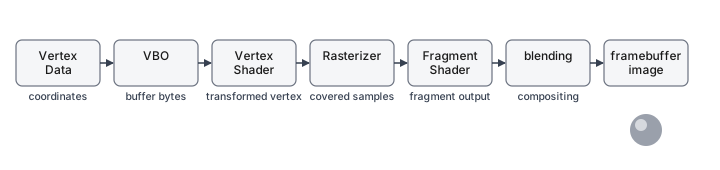
The simplified pipeline used here is:
Vertex Data -> Vertex Buffer Object (VBO) -> Vertex Shader -> Rasterizer -> Fragment Shader -> blending and other later per-fragment operations -> framebuffer image.
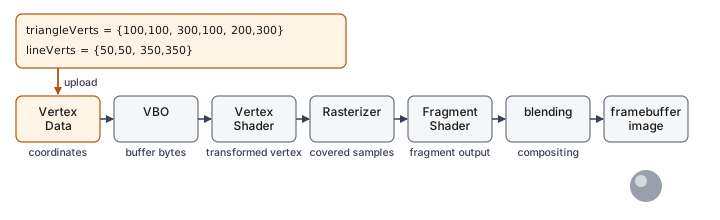
Vertex Data is the application's geometric input, such as position coordinates stored in arrays. That data is uploaded into a VBO before drawing. The vertex shader processes each submitted vertex. The rasterizer converts assembled vector primitives such as triangles into fragments and produces interpolated per-fragment attributes when those attributes exist. The fragment shader computes output values for those fragments. Later framebuffer operations, including blending when enabled, determine how fragment outputs contribute to the final image.
The standard pipeline diagram shows these stages as connected boxes ending at a rendered framebuffer image. The vertex-data version of the diagram attaches the source vertex array to the Vertex Data stage so the transition from application data into the graphics pipeline is explicit.
Read
- Read the chapter: Graphics pipeline